
A Book, a Letter, and a Reminder to Stay in the Healthcare Arena
May 25, 2026
A few days ago, I had one of those strange moments that felt symbolic in retrospect.
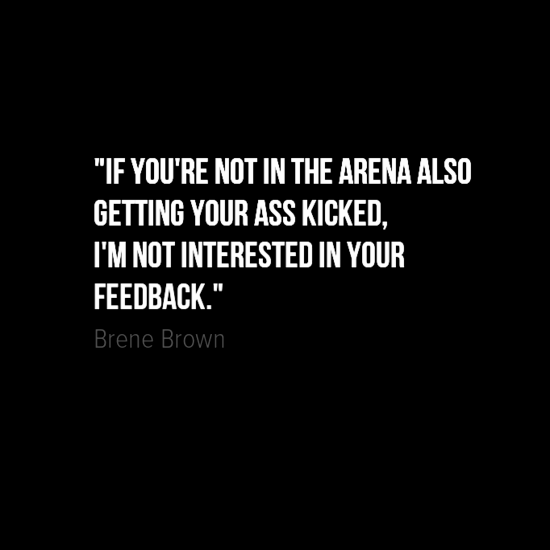
As many people know, we’ve been building Evra around a fairly simple but ambitious idea: that healthcare in the United States must evolve beyond episodic care and become more continuous, preventative, intelligent, and human-centered. At the same time, I’ve been spending a lot of time thinking about the systems-level forces that shape healthcare: not just technology, but culture, incentives, trust, and the kinds of people who are driving meaningful change. Brené Brown talks about this as being “in the arena:” showing up, creating, and “daring greatly.”
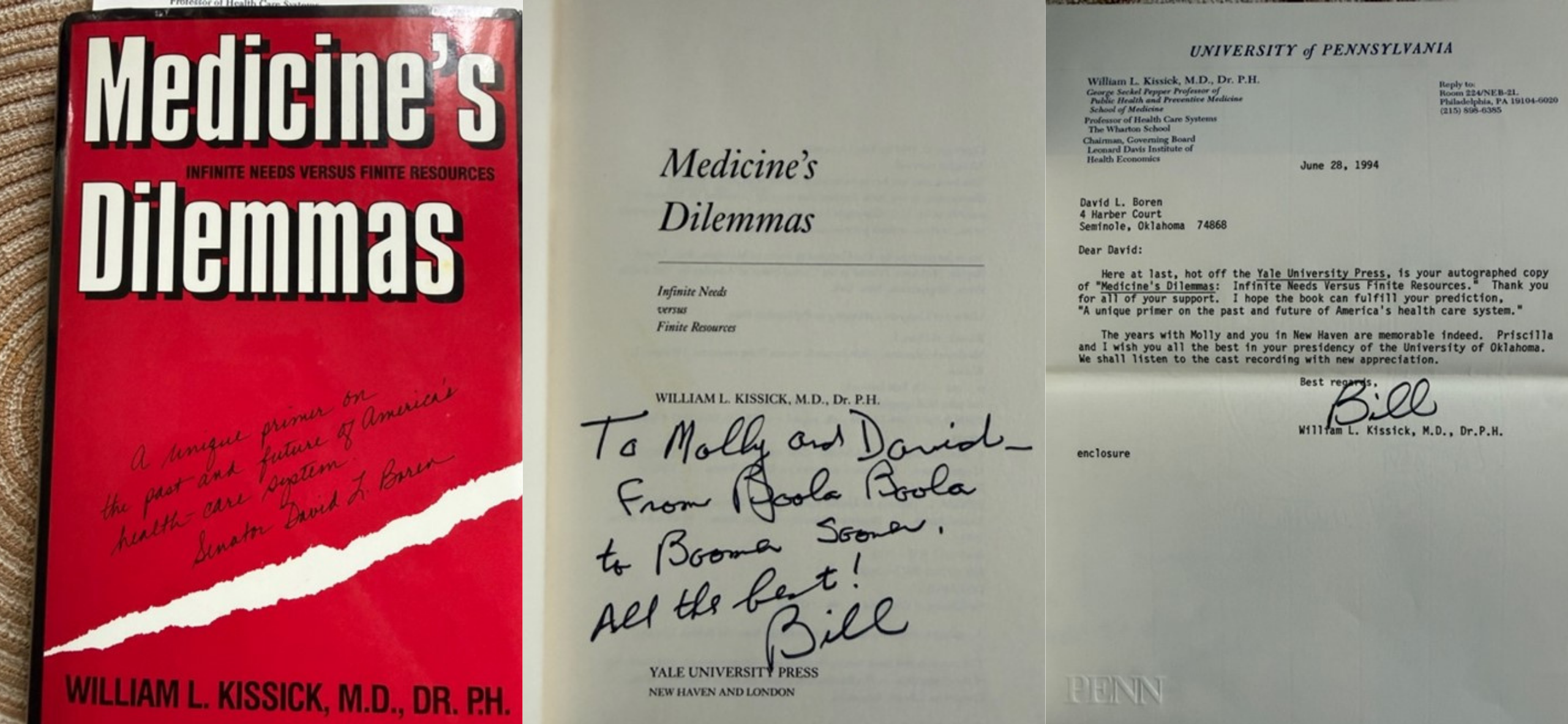
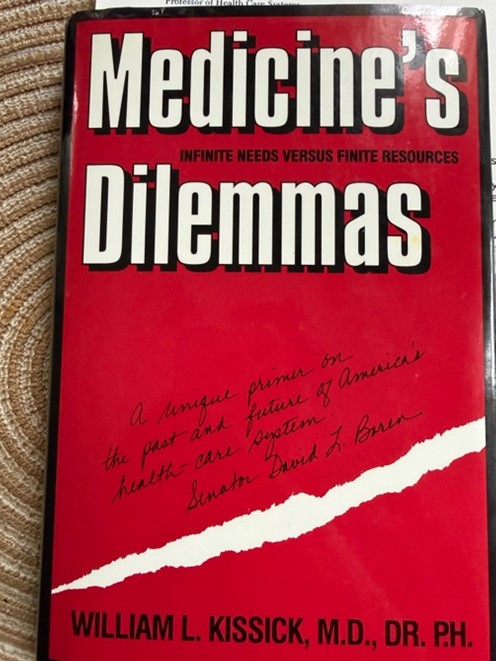
Around the same time these thoughts were intensifying, a dear mentor and polymath, Stephen Klasko, recommended I read Medicine’s Dilemmas by the late William Kissick — the physician and Wharton professor whose work on healthcare systems became foundational to modern policy thinking. The book carries a front-cover blurb by the late Senator David Boren (D-OK), who played a meaningful role in healthcare reform conversations during the Clinton era. Kissick passed away in 2013. Boren passed away in 2025.
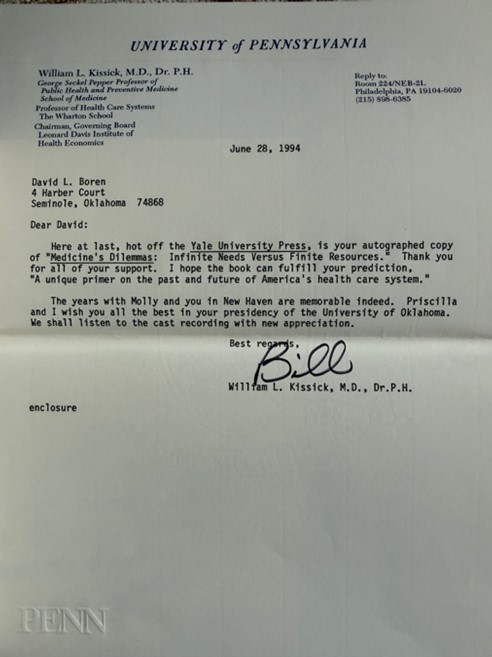
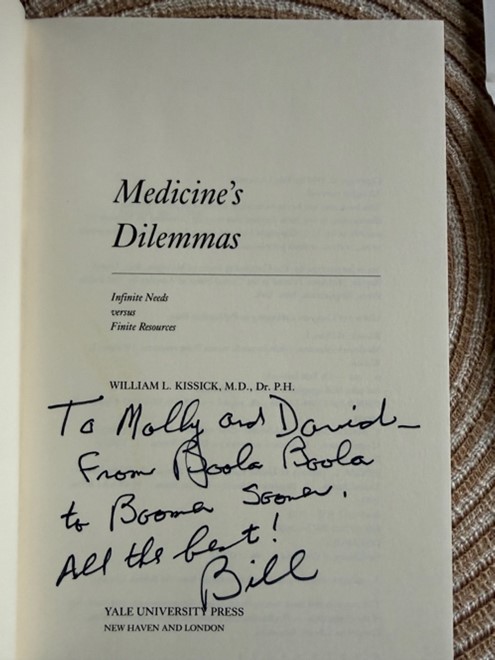
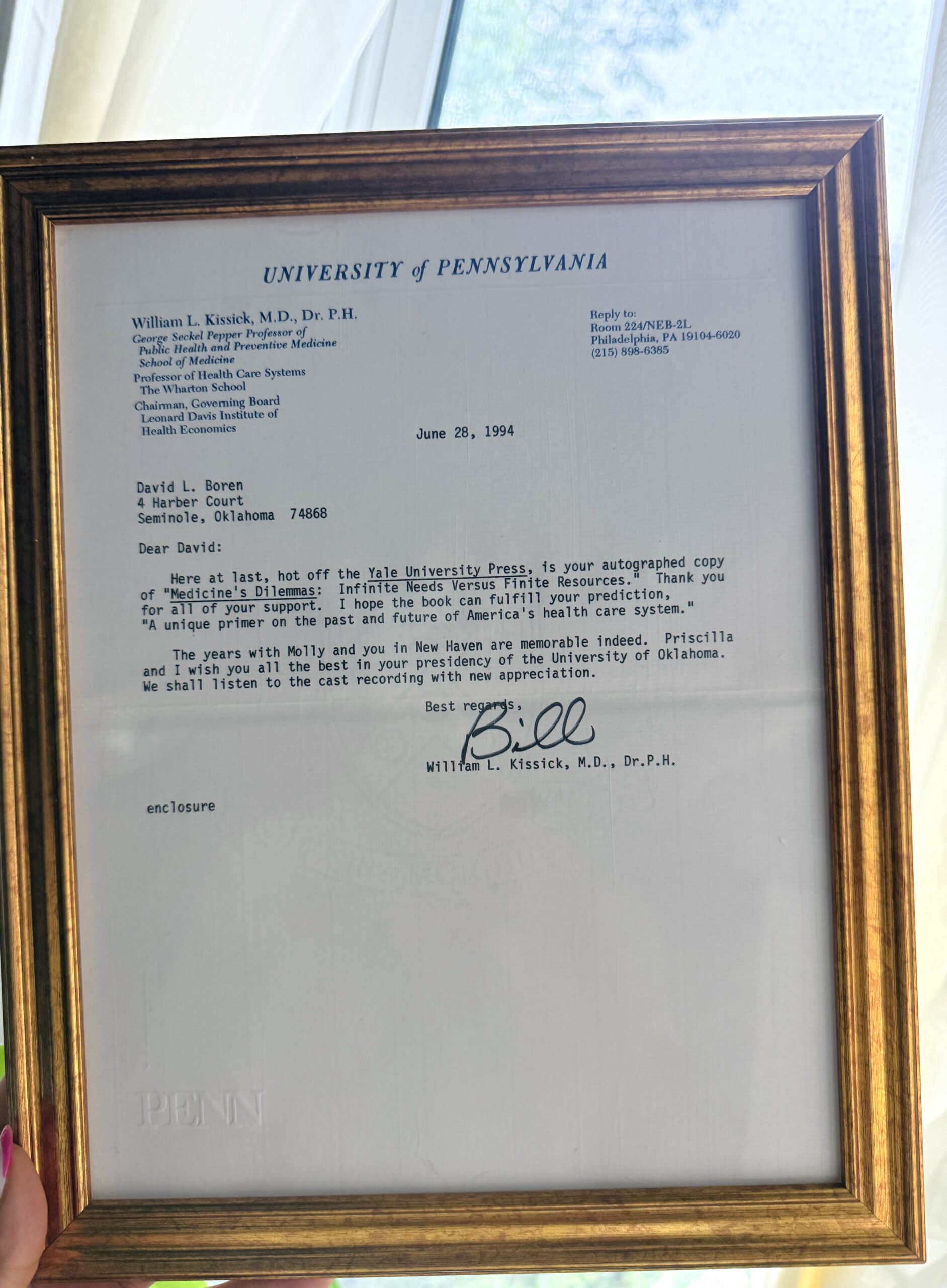
The copy that arrived at my house in Washington, DC, last Friday happened to be the exact copy Kissick had signed for Boren, complete with an accompanying letter dated June 28, 1994.
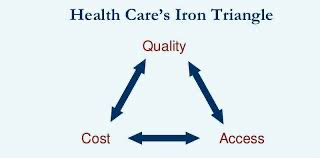
For anyone who has spent time thinking seriously about healthcare systems, Kissick’s “iron triangle” — the tension between cost, quality, and access — is foundational. It remains one of the most enduring frameworks in healthcare policy because it emerged from decades of engagement with real institutional complexity. And Boren represented a generation of healthcare leadership that still believed thoughtful, constructive dialogue mattered in shaping public systems.
Holding that signed book in my hands — and later framing the letter — stopped me for a moment. Not because I believe objects themselves are magical, but because timing sometimes clarifies things emotionally before it clarifies them intellectually. It felt like a reminder of a very different era of healthcare conversation: one grounded in seriousness, rigor, institutional responsibility, debate, and long-horizon thinking.
Ironically, it also helped me make sense of something much more modern: the strange dynamics of highly online professional communities.
Over the past several years, healthcare — like nearly every other field — has developed increasingly online ecosystems. LinkedIn, Slack groups, Twitter/X, Substacks, Discords, podcasts, and niche communities now shape enormous amounts of professional discourse. Some of these spaces are genuinely useful. They help people enter fields, find jobs, build networks, discover ideas, and feel less isolated professionally.
But over time, many online ecosystems begin optimizing for something slightly different than actual execution.
Brené Brown often speaks about the difference between being “in the arena” versus observing from the stands. The people in the arena are the ones actually building companies, caring for patients, conducting research, creating policy, pursuing in-depth healthcare reporting, navigating regulation, taking risks, and trying — imperfectly — to move systems forward. They are often bruised, uncertain, exhausted, but deeply focused and earnest. And perhaps most importantly, they are usually too busy doing the work itself to spend all day curating a constant online presence around the work.
That distinction increasingly feels important in health tech.
A thoughtful friend recently framed it even more simply: perhaps many of the people most deeply “in the arena” are increasingly gathering elsewhere — in smaller circles, invite-only gatherings, policy discussions, research collaborations, and communities built around execution rather than visibility. Admission into those spaces is often based less on online presence and more on a demonstrated track record of building, researching, operating, or creating meaningful change. I have been fortunate, over this past year as a founder, to be invited to many of these spaces as an attendee or presenter, and I always leave those gatherings more inspired and rooted in a community of 'doers.'
That observation stayed with me because it helped clarify that many online ecosystems are structurally optimized for visibility, engagement, commentary, and identity-building rather than long-horizon institutional change.
The incentives are understandable. Attention drives growth. Communities need activity to survive. Platforms reward engagement. But once engagement becomes the primary currency, discourse can gradually distort. The loudest voices are not always the most experienced or thoughtful. Online ecosystems often reward consistency of engagement and visibility more than depth of expertise or long-horizon execution. Speculation can begin masquerading as insight. Gossip can begin masquerading as analysis. Promotion can sometimes blur into advertising. Meanwhile, many people building difficult things simply disengage rather than participate in increasingly performative environments.
Importantly, this is not unique to one platform. It can happen on LinkedIn, Slack, Twitter/X, podcasts, or any ecosystem where professional identity and social visibility become intertwined. And ironically, the people most deeply “in the arena” are often the least online, with a few notable exceptions. They may share selectively, but they are generally too occupied with the realities of execution — running companies, conducting research, navigating stakeholders, building teams, caring for patients, or shaping policy — to spend large amounts of time maintaining a constant commentary strategy.
That creates an interesting distortion in modern healthcare discourse: the people shaping the narratives about healthcare are not always the same people meaningfully shaping healthcare itself.
And in some of these spaces, the hunger to be closer to the arena is palpable. Since building Evra, I’ve received many DMs and emails from people seeking opportunities to advise, partner, invest, be hired, or otherwise get involved. Occasionally those conversations are thoughtful and generous. Often, the quality of the outreach itself reveals a great deal: whether someone is intellectually generous, whether they are operating with integrity, whether they are curious before they are transactional, and whether they can handle a “not yet” or “not aligned” with maturity.
That matters, because teams are built through discernment. At Evra, we choose teammates, advisors, investors, and partners very thoughtfully. We do not want a culture built around gossip, cliques, entitlement, or performative proximity to the work. We want one built around trust, rigor, respect for different skills and perspectives, and deep focus on the mission. I’m proud that since Evra began, we have not had a single person leave voluntarily or involuntarily. That will not always be the case — people grow, life changes, and new opportunities emerge — but I do believe it speaks to the culture we are trying to build. And in healthcare, culture is not separate from product. It ultimately shows up in what you create.
And perhaps that’s what made the Kissick/Boren coincidence feel unexpectedly grounding.
Reading the letter made it personal. They were friends and allies, not merely colleagues discussing abstract policy ideas. It reminded me that long before social media algorithms, engagement metrics, and online banter, healthcare progress was still being driven by people willing to step directly into complexity: policymakers, physicians, researchers, operators, patients, and institutional thinkers willing to wrestle with imperfect systems over decades. They disagreed. They debated intensely. But the center of gravity remained the work itself.
Today, we have exponentially more technology, more ways to connect, and more ways to speak. But technology alone does not create wisdom, integrity, or meaningful change. At the center of healthcare transformation still must be people willing to enter the arena itself: to build, to research, to care for patients, to challenge systems thoughtfully, to debate rigorously and respectfully, and to accept the risks and responsibilities that come with trying to improve something as complex and antiquated as healthcare.
Holding that signed Kissick book felt, in some small way, like a reminder of that responsibility.
Not to become louder than the noise of online ecosystems.
Not to become distracted by increasingly performative discourse.
But to stay focused on the actual work: fulfilling a difficult vision and finding the right friends, allies, and collaborators willing to do that work alongside us.
At Evra, we are fortunate to have a deeply driven and high-integrity team, along with partners who care profoundly about the future of healthcare. Together, we are trying to stay firmly grounded in the arena itself — working toward a vision of what healthcare could become in the United States and globally.
It is a team that believes, wholeheartedly, that advances in artificial intelligence and technology may, for the first time, fundamentally reshape Kissick’s iron triangle itself: that improving quality and access may actually reduce costs through scalable care, earlier intervention, reduced errors, and greater personalization.
Perhaps, someday, we may even call it the “ironic triangle.”
To quote Brené Brown again, it is a team emboldened to “dare greatly” — for our country, our world, and the generations that come after us.
And I hope more people will choose to step into the arena too.
— Amitha